Showing posts with label Top 50 Decisions. Show all posts

Thursday, October 31, 2013

Decisions: Final Installment.

Time to close out TR Sullivan's list of the top 50 decisions that made the Rangers who and what they are today. Kind of a big chunk to finish things off but I couldn't get the list to end evenly so here it is:

#43. Band-aiding the Stadium - Arlington Stadium was originally a minor league park. When the Senators moved to Texas the capacity was hastily expanded from 20,000 to 35,000. The Rangers spent the next 20 years trying to fix it. It ended up looking like a child's Play-Doh creation.

#44. Charlie Hough - Purchased on the cheap from the Dodgers in 1980, he went from reliever to starter to ace of the staff. Charlie, shown here on a signed 1988 Leaf card, was the heart and soul of the Rangers pitching staff for a decade.

#45. Opportunity lost - Jim Sundberg rejected a 1982 trade that would have sent him to the Dodgers for Orel Hershiser, Dave Stewart, and others. That same year the Rangers traded pitchers Walt Terrell and Ron Darling to the Mets for Lee Mazzilli. Think about the pitching staff they could have had if the first trade went and the second fell through.

#46. Short to Corbett - Brad Corbett bought the team from Bob Short in 1974 but couldn't keep his hands off. The Rangers ended up running in circles during his time as owner.

#47. Denny McLain - Ted Williams advised against the trade that sent Ed Brinkman, Aurelio Rodriguez, and Joe Coleman to Detroit in exchange for a washed-up Denny McLain. He was right. The three were front-line players for Detroit's division title team in 1972 while the Rangers were getting hammered.

#48. Big Broadcasting - In 1981 the Rangers started broadcasting on cable television for the first time because of the leadership of Merle Harmon. In 1982 Mark Holtz and Eric Nadel were paired together on radio for the first time.

#49. Frank Howard - The Senators sent Claude Osteen to the Dodgers on December 4, 1964 as part of a deal for Frank Howard. Hondo would become the marquee player for the Senators.

#50. Sundberg/Hargrove - Each had just one year of minor league experience when manager Billy Martin kept them on the Opening Day roster for 1974. Those were two of the key moves that sparked the Rangers turnaround season that year.

Here we are at the end of Sullivan's list. Some of it I disagreed with and some I had never heard of. Most of it was spot on. I hope you enjoyed the series.

Friday, October 11, 2013

Decisions: #38 - #42.

Moving on in T.R. Sullivan's list of Top 50 Decisions that have Shaped the Rangers.

#38 Staying West - Baseball was looking at a serious realignment that would have included the Rangers. Owner Tom Hicks helped counter the movement when he agreed to stay in the American League West in exchange for an annual home-and-home series with the Houston Astros. (Seems to me like it's time to re-visit this one with the Astros now in the AL West.)

#39 The Surprise move - The Rangers moved into one of the best Spring Training facilities in baseball when they moved to Surprise, Arizona in 2003.

#40 Josh Hamilton - Opinions differed at the time and there are still some who don't like it but trading Edison Volquez for Josh Hamilton was huge. Hamilton may not be able to control his mouth, but he could hit and field when he was with Texas and helped put them in their first World Series.

#41 Young to Designated Hitter - Michael Young, shown here on card 230 of the 2005 Donruss Diamond Kings set, switched positions three times after coming up as a second baseman. His 2011 switch to DH/super utility man was probably the biggest. His reaction to that move likely contributed to his being dealt to Philadelphia during the 2012-2013 off-season.

#42 Buck Showalter - He brought some success when he was hired in 2002. Just like Billy Martin and Bobby Valentine though, his early success created too much false hope.

Wednesday, October 2, 2013

Decisions: #33 - #37.

So the Pirates sent the Reds home last night and either the Rays or Indians will go home tonight. For some reason I just can't get too into these early playoff games.

Decided that the quick walk-through of the remaining items will work for the Top 50 Decisions that shaped the Rangers as well as the Top 50 Odd Moments. Here's the next few decisions from T.R. Sullivan's list:

#33 The Turnover - The Rangers won 95 games in 1977 and finished second in the American League West. Over the next two years they made a dizzying array of trades and free-agent signings to try and get over the top. Bert Blyleven, Gaylord Perry, Toby Harrah, and Mike Hargrove were among the players who left. Buddy Bell, Al Oliver, and Jon Matlack were some of the arriving players. It didn't work and Texas went into decline.

#34 The Merger - After Tom Hicks bought the Rangers, he merged the Stars and Rangers into one entity called the Southwest Sports Group. The SSG sold off property, introduced Ameriquest Field as the name of the Ballpark in Arlington, and changed the red uniforms. Perhaps the only good part was the uniforms.

#35 Hicks buys Liverpool - After creating SSG, Tom Hicks bought the English football (soccer) team at Liverpool. Not sure exactly what led to his fortune evaporating but it seemed to accelerate when he ventured into overseas sports.

#36 Ryan's Return - When Nolan Ryan, shown here on card 686 of the 1991 Score set, was named club president in 2008 it seemed to stabilize things. That gave the club some of the leadership it needed going through the trouble that lay just ahead.

#37 Selig supports Greenberg - Bud Selig's support for the ownership group headed by Chuck Greenberg seemed to sway the outcome of the 2010 bankruptcy sale. Otherwise it seems likely that Mark Cuban would have ended up with the team.

Friday, August 30, 2013

Decisions: Marching Through Atlanta.

Time for another excursion into T.R. Sullivan's Tops Fifty decisions that made the Rangers. Up to number 32 on the list.

The 1988 winter meetings were in Atlanta, Georgia. Texas General Manager Tom Grieve went with the intention of doing some dealing. He was able to make two headline trades.

On December 5, 1988 Grieve pulled off a trade for first baseman Rafael Palmeiro. Pitchers Jamie Moyer and Drew Hall came along as well but Palmeiro, shown here on card 1T of the 1989 Score set, was the centerpiece of the deal. A couple of minor leaguers and four Rangers, including Mitch Williams and Curt Wilkerson, went to the Cubs in return.

On December 6, 1988 Grieve snagged second baseman Julio Franco from the Indians. In return the Tribe got Jerry Browne, Pete O'Brien, and Oddibe McDowell. 

What was significant about these two trades was the change of direction they signaled for the club. The Rangers were about to go big-gun offense. The July, 1989 trade for Harold Baines further solidified the change in philosophy. By the end of 1989 the Rangers scored 58 more runs than in 1988. The team also increased their home run totals by 10.

Within a few years Dean Palmer, Juan Gonzalez, and Ivan Rodriguez would become key components in the Texas offense. For the next two decades the Rangers would try to bomb their way to the World Series. 

Not that pitching was totally ignored, Texas did sign Nolan Ryan on December 7, 1988. However, it wasn't until the arrival of General Manager Jon Daniels and the departure of owner Tom Hicks that pitching would again carry as much weight in Arlington as slugging.

Wednesday, August 14, 2013

Decisions: Going for Broke.

Time for another look at TR Sullivan's list of the Top 50 Decisions that shaped the Texas Rangers. Today we come to number 31 on the list - Going for Broke.

On January 26, 2001 the Texas Rangers signed shortstop Alex Rodriguez to a ten year deal. The signing was at odds with the youth movement the team was engaged in at the time but the club had suffered through a losing season in 2000 after appearing in the post-season in 1999. Owner Tom Hicks wanted to get back to winning and buying talent seemed to be the faster track than growing it.

2001 was not the return to winning the Rangers wanted. Manager Johnny Oates lasted just 28 games and the team ended up with only two wins more than the previous season. Time was ticking on the Rodriguez contract and management needed to justify the money involved. Winning now seemed to be the best option.

Overboard went the youth movement. In came veterans through trades and signings. Carl Everett, shown here on card 35 of the 2002 MLB Showdown Trading Deadline set, Chan Ho Park, John Rocker, Todd Van Poppel, Ismael Valdez, and Hideki Irabu all arrived during the off-season via trade or free agency. Former Ranger Juan Gonzalez returned as a free agent signing. It was one of the most extension re-workings of the Texas roster in team history. It also effectively ended the youth movement by blocking or trading most of the young prospects.

As might be expected, the moves didn't work. In 2002 the team lost one more game than they did in 2001 and remained in the American League West cellar. Manager Jerry Narron lost his job as did several of the new arrivals. Park was about the longest-tenured of the acquisitions, lasting until 2005. Texas didn't get much in return for any of the departures.

It was time to get back to the drawing-board and restart the youth movement. That would take some time though and, with the exception of 2004, the team remained stalled out at sub-.500 play until 2009. Tom Hicks never did get his championship and set the franchise hopes back almost a decade. Turned out the shortcut really wasn't.

Friday, June 14, 2013

Decisions: John Burkett.

In an effort to avoid discussing the train wreck in progress that is the Rangers current home stand I will be returning to T.R. Sullivan's Top 50 Decisions that have shaped the franchise.

Number 30 on the list is the August 8, 1996 trade that brought John Burkett, shown here on card 213 of the 1997 Score set, to Arlington. Texas was looking to make a run and sent Ryan Dempster and a player to be named later to Florida for Burkett. Rick Helling made the trip to Florida in September of that year to complete the deal.

Sullivan maintains the acquisition of Burkett was the pivotal move that put the Rangers over the top on their way to the division title in 1996, the first in team history. Much like the Cliff Lee deal in 2010.

Following the trade, Burkett made ten starts for the Rangers while pitching a total of 68.2 innings. In spite of posting a 4.06 ERA and a 1.325 WHIP he won five of his starts while losing just 2. Additionally, Burkett grabbed the Rangers only post-season win until 2010.

Based on John's numbers alone one has to question the validity of his inclusion on the list. However, once the numbers of the rest of the starting rotation are considered the case becomes a bit more convincing. Of the five other Texas pitchers who made more than 10 starts in 1996, three had ERA's over 5.00 and one over 4.50. Ken Hill and his 3.63 ERA were the only bright spot in the rotation. Once that is taken into account a 4.06 ERA looks better and the impact can be seen more clearly.

The impact on the franchise of Texas' appearance in the 1996 playoffs cannot be underestimated. For the first time winning the division and making it to the post-season was not a far-fetched dream, it was reality. The players, fans, and front office got the taste of October baseball and liked it. That would result in two more trips to the post-season in 1998 and 1999 as well as a vision that would lead to the World Series in 2010 and 2011.

Wednesday, May 8, 2013

Decisions: David Clyde.

Another flat performance by the offense last night as the Rangers fell to the Brewers. At least the A's also lost and couldn't make up any ground. Back to the Top 50 Decisions that have made the Rangers what they are today.

Number 29 on the list is the David Clyde saga. Clyde, shown here on card number 76 of the 1999 Sports Illustrated set, was the number one draft pick in 1973. An extremely talented lefty, he had scouts and sports writers predicting a Hall of Fame career.

Unfortunately David was drafted by a team in serious financial trouble. Rangers owner Bob Short moved the team to Texas in 1972 because he was going broke in Washington DC. In the meantime some of his other investments were falling through. With cash drying up, Short needed to sell the team. When you're last in the American League and putting just 6,000 fans in the seats per game, selling becomes a difficult proposition.

Somebody, some say Short, some say Clyde, proposed David make two starts before heading off to the minors. On July 27, 1973 David Clyde made the jump from high school to the Major Leagues. Clyde lasted five innings and beat the Minnesota Twins. He also attracted over 35,000 fans and sold out Arlington Stadium for the first time since the Rangers came to town. His second start came against the Tigers and was another win.

Bob Short overruled manager Whitey Herzog and declared Clyde to be a permanent member of the team. With Billy Martin replacing Herzog as manager, the last protection for the young arm was gone. So was Clyde after just two seasons and one appearance in 1975.

David Clyde never reached his full potential with the Rangers or with any other team. In large part that was due to Bob Short holding him in the Majors and Billy Martin over using his arm. Without the seasoning and instruction in the minors Clyde was not prepared to face Major League hitting.

What Clyde did do was sell tickets. When he pitched in 1973 he drew 20,000 fans on average. That was well above the norm for a team that lost over 100 games that season. The revenue enabled Short to convince Brad Corbett that baseball in north Texas was a viable business. That got the team sold and Short out of baseball. That was good news.

Clyde also influenced the Rangers and baseball in another way, the way young prospects are treated. Promotion from high school to the Majors is almost unheard of and young players are expected to spend some time in the minors. The way the Washington Nationals have handled Bryce Harper and Stephen Strasburg is a good example. The refusal of the Rangers to rush young pitching in recent years is another. Even with financial and contention pressures arguing for quick promotion, the specter of David Clyde's ruined career exerts an opposing pressure. Nobody wants to be responsible for the next David Clyde.

Wednesday, May 16, 2012

Decisions: Four in one.

Doing a rare no scan post today. Got busy before work and now I'm trying to get this posted on my dinner break. Due to the Rangers anemic offense and a couple of poor throws by Colby Lewis the Royals came out on top last night. Not much else to discuss so this strikes me as a good time to take another look at T.R. Sullivan's list of the Fifty Decisions that have shaped the Rangers as a franchise. The lack of a scan works out since the next few entries really don't have a specific player attached to them.

Number 24. San Diego. Astros owner Roy Hofheinz convinced the National League to expand in San Diego in 1969. Dallas had also been under consideration.

Number 25. Sorry Charlie. Charlie Finley started looking to move the Athletics out of Kansas City almost as soon as he bought them. In 1964 he tried to take the team to Dallas. The American League turned him down and the team later went to Oakland instead. That meant no Catfish Hunter, Reggie Jackson, or Vida Blue in Texas. As a side note: Mrs. Spiff is particularly grateful for this entry, she has no interest at all in the A's green and gold.

Number 26. Mike Stone. Eddie Chiles hired him as the club president in 1984. T.R. credits Stone with bringing a real sense of professional organization to the franchise.

Number 27. Sandy Johnson. Hired by Tom Grieve to oversee scouting and player development, he helped build the Rangers farm system into a real talent pipeline that eventually included Juan Gonzalez and Ivan Rodriguez.

Wednesday, April 18, 2012

Decisions: Jose Canseco.

Got class today and church activities this evening so this is a pre-scheduled post. Will be back tomorrow.

Number 23 on T.R. Sullivan's Top 50 Decisions that shaped the Rangers is the 1992 trade for Jose Canseco. In return for Jose, shown here on his 1995 Baseball Aces playing card, the Rangers sent Ruben Sierra, Jeff Russell, and Bobby Witt to Oakland.

I have expressed my views on this trade in a previous post. T.R. says it makes the list because it put the Rangers at ground zero of baseball's performance-enhancing drug scandal. That's true. Lots of the guys who played with Canseco in Texas later appeared in his books and in the Mitchell Report. Not good stuff. Kind of makes the bone-headed plays and blowing one's arm out while pitching look like kid stuff.

Friday, March 30, 2012

Decisions: Trading Loaiza.

On July 17, 1998 the Rangers traded Warren Morris and Todd Van Poppel to the Pirates. In return they got pitcher Esteban Loaiza. Loaiza, shown here on card 485 of the 1999 Fleer Tradition set, lasted with Texas until July 19, 2000. On that date the Rangers traded him to the Blue Jays.

While with Texas, Esteban Loaiza never had an ERA under 4.50. His highest season win total was nine games. Not exactly a barn-burner.

In return for Loaiza, Toronto sent two players to Texas. The first was pitcher Darwin Cubillan. Darwin's Texas experience was a train wreck. In 17.2 innings pitched he posted a 10.70 ERA. In May of 2001 Texas sent him to Montreal.

The second player that the Rangers picked up in the trade was Double A middle infielder named Michael Young. Mike arrived in Arlington for good in 2001 and hasn't looked back. Eleven years later he is the steady veteran presence on the team. He is currently in the top ten for the franchise all time in batting average (.304), total bases (3,060), home runs (169), RBI (917), walks (499), and stolen base percentage (75.65%) . He holds the franchise records for games played (7,396), at-bats (6,788), plate appearances (7,396), runs scored (1,006), hits (2,061), doubles (388), triples (52), and singles (1,452). He's also been an All-Star seven times and has one Gold Glove to his credit.

Clearly the Michael Young trade helped make the Rangers what they are today. He's had an impact far above what Texas gave up to get him in 2000.

Wednesday, March 21, 2012

Decisions: Trading for Harold.

In 1989 the Rangers were in the midst of a rebuilding stretch. They would end up finishing in 4th in the American League West with a 83-79 record. That was to be expected. What was not expected was the trade that took place on July 29th.

Texas obtained the services of Harold Baines, shown here on card 62T of the 1989 Score set, and Fred Manrique from the White Sox. In return the Sox got Scott Fletcher, Sammy Sosa, and Wilson Alvarez. The trade was a disaster for Texas.

By the time he found himself in Arlington, Harold Baines was a full-time DH. He didn't like playing in Texas and the Rangers ended up trading him in 1990 to the Oakland A's. In return Texas got Scott Chiamparino and Joe Bitker. Neither pitcher ever panned out for the Rangers. Between trades Baines appeared in 153 games for Texas - almost a full season's worth. He hit .288 and managed a .363 on-base percentage and a .428 slugging percentage. Not bad for a position player but short of expectations for a DH.

Fred Manrique lasted through the end of the 1989 season with Texas and played in a total of 54 games. His .288 batting average and .318 on-base percentage were higher and lower respectively than Fletcher's .239 and .323 prior to the trade. The two were about interchangeable in the field. In April of 1990 Texas traded Manrique to the Twins for a career minor-leaguer and cash.

Meanwhile Scott Fletcher played three more years for Chicago and made up for the absence of Fred Manrique. Wilson Alvarez spent all or parts of seven seasons with the White Sox. His combined record was 67-50 and his ERA 3.76. When the Sox finally traded him in 1997 one of the players they got in return was Keith Foulke. Sosa spent just three seasons with the ChiSox. He wasn't anything to write home about with his total .227 batting average and .276 on-base percentage but he was a sight better than what the Rangers got in return.

All in all the trade worked well for Chicago and spelled trouble for Texas. Two promising young players gone with nothing long-term to show for the loss. There wasn't even an immediate return as the team ended 1990 with the same 83-79 record that they had in 1989.

Friday, March 9, 2012

Decisions: Hiring Ted.

The Senators going to the the Wrong Bob directly led to today's installment in T.R. Sullivan's Top 50 Decisions list. One of the first things that Bob Short did after naming himself as General Manager was to fire manager Jim Lemon and hire Ted Williams.

From 1964 to 1967 the Senators had been making slow but steady improvement under manager Gil Hodges. The wheels came off in 1968 under Lemon and the team plunged to the American League basement. The team desperately needed direction. What they got was Ted Williams, shown here on card number 260 of the 1978 TCMA set.

It is certain that Bob Short figured that Williams' name and fame would bring the Senators attention and put fans in the seats. He may have even thought that Williams would be a decent manager. At least he got a few headlines and one winning season out of the deal.

During his playing career Ted Williams was known as one of the most prickly personalities in the game. He often grew short tempered with players of lesser ability and focused almost solely on his hitting. He made statements about how he hated pitchers and his attitude seemed to back it up. When he retired he stated that he was done with baseball and would never be interested in managing.

A five year contract worth $500,000 changed Teddy's mind. Unfortunately it didn't change his attitude or way of dealing with others. After a winning season in 1969 that attitude and demeanor started to catch up with him and the ballclub.

Three examples of Williams' managing style help explain why perhaps his players might not play well for him. While riding in a cab, players Dick Nen and Tim Cullen stopped to pick up Williams. Williams thanked them by explaining to Nen that he could be a pretty good hitter if he changed the type of hitter he was. Cullen then asked Ted what kind of hitter he thought Cullen was. Ted told Cullen that he considered him to be the dumbest hitter in the league.

With a large lead and pitcher Casey Cox struggling on the mound, Williams walked to the end of the bench where the other pitchers were sitting. Looking at them he said, "I never liked pitchers when I was playing and you all aren't giving me any reason to start now."

Late in a ballgame in 1972 Williams needed a pinch-hitter. Approaching a young Tom Grieve he said, "I guess you're all I got left. Get out there and see if you can do anything."

Working the reverse Gil Hodges method, Williams took the team from a .531 record in 1969 to .432 in 1970, .396 in 1971, and .351 in 1972. Some of this was due to Short's inability to fund the team properly but a lot was due to Williams' inability or unwillingness to relate to his players properly. The lack of winning led to the lack of funding which led to the lack of winning which led to more poverty which led to a team move.

Quick housekeeping note: I will be dealing with a death in the extended family over the next few days. I will try and schedule posts but obviously won't be able to post on any news out of Spring training.

Thursday, March 1, 2012

Decisions: Trading Juan.

Number 19 on T.R. Sullivan's list of the top fifty decisions that have shaped the Rangers history is the trade of Juan Gonzalez on November 2, 1999. Sullivan states that the trade brought an end to the successful Melvin-Oats run and the return did not have the desired effect.

Of course Juan wasn't the only player involved in the trade. Texas also sent Danny Patterson and Greg Zaun to the Tigers. In return Texas received Bill Haselman, Frank Catalanotto, Fransisco Cordero, Gabe Kapler, Alan Webb, and Justin Thompson.

So how best to evaluate the trade? Well, let's start with Alan Webb. He was a career minor league pitcher who never made it above Double A in the one season he pitched in the Rangers system. A non factor.

Next let's take a look at Bill Haselman and Greg Zaun. Both were backup catchers in 1999 and Haselman continued in that role in 2000. In 1999 Zaun hit .247 with an on-base percentage of .314 for Texas. In 2000 Haselman posted a .275 batting average and a .329 on-base percentage for the Rangers. Probably a slight advantage to Texas here.

Pitchers. There were three pitchers involved in the trade: Danny Patterson, Fransisco Cordero, and John Thompson. Thompson promptly tore his rotator cuff and missed the entire 2000 season. Four surgeries later he appeared in two games for Texas in 2005. He posted a 21.60 ERA in 1.2 innings before retiring. Cordero spent 6 plus seasons with the Rangers. After an ugly 2000 season he settled down and turned in a decent performance in 2001 and strong showings in 2002, 2003, and 2004. In 2005 he was good but not sparkling. A poor start to the 2006 season led to his being sent to the Brewers.

Patterson was a top prospect for Texas but never seemed to pan out. After being sent to Detroit he lasted five years without ever getting his ERA below three. He also had 72 saves less than Cordero did in the same time span. Slight advantage to Texas on the pitcher side of things.

Obviously the main player leaving in the trade was Juan Gonzalez. In 1999 Juan had played in 144 games for Texas. He had tallied a .326 batting average, a .378 on-base percentage, a .601 slugging percentage, 128 RBI, 39 home runs, 36 doubles, and 114 runs scored. In 2000 for the Tigers he would see his numbers drop to a .289 batting average, a .337 on-base percentage, a .505 slugging percentage, 67 RBI, 22 home runs, 30 doubles, and 69 runs scored.

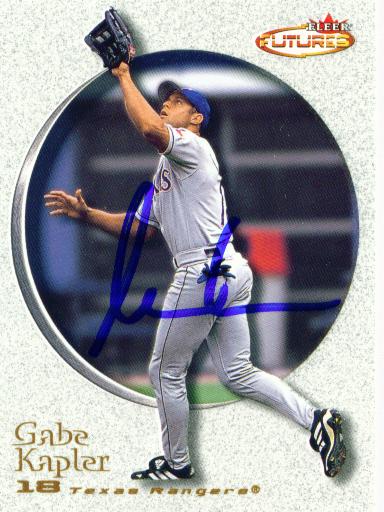
In return Gabe Kapler, shown here on a signed 2001 Fleer Futures card, appeared in 116 games for Texas in 2000. He posted a .302 batting average, a .360 on-base percentage, a .473 slugging percentage, 66 RBI, 14 home runs, 32 doubles, and 59 runs scored. Cat appeared in 103 games for Texas in 2000. He ended up with a .291 batting average, a .375 on-base percentage, a .457 slugging percentage, 42 RBI, 10 home runs, 13 doubles, and 55 runs scored.

What Texas lost when they sent Juan Gonzalez to Detroit was power. The other players involved in the trade pretty much balanced each other out but Kapler and Catalanotto were just not able to replace the boom in Juan's bat. Of course Juan wasn't able to replicate his 1999 season either. After 2000 he had just five seasons left - only one of those would be even close to the Gonzalez who had powered the Texas batting order.

So, did the trade bring an end to the Rangers' success? Looking at the numbers I think it's hard to conclude that it did. Gonzalez just wasn't as effective after 2001 as he was before. Even bringing him back to Texas in 2002 didn't help.

Perhaps what the trade did was lower the curtain. The successful run was over, what Gonzalez's departure did was to confirm that in the minds of the fans. As to the return? Well, it obviously did not have the desired effect since the team did not return to the postseason with those players.

Wednesday, February 15, 2012

Decisions: Wrong Bob.

With just days left before the official commencement of the 2012 Spring Training we come to number 18 in T.R. Sullivan's Top 50 Decisions that have shaped the Rangers.

In 1968 the Senators were for sale. One partner had passed away and the other was looking to sell the team in the face of large financial losses.

The team ended up going to Bob Short for $9.4 million. He outbid a group headed up by Bob Hope. Unfortunately Short borrowed almost all of his funds. The result was a mad and unsuccessful scramble for funds to make the team pay off.

That scramble resulted in card number 462 of the 1971 Topps set being the last Senators team card issued as the team moved to Texas during the off-season. It also resulted in David Clyde being sent straight from high school to the Majors in an ill-advised publicity stunt. All in all the team clearly went to the wrong Bob.

Wednesday, February 1, 2012

Decisions: Will Clark.

Number 17 on T.R. Sullivan's list of 50 Top Decisions in franchise history is the signing of Will Clark. Clark, shown here on card 350 of the 1994 Upper Deck set, was signed by Texas on November 22, 1993. He would stay with the team until being granted free agency in November of 1998.

T.R. says that Clark "single-handedly infused the Rangers with a team-first winning attitude." I'll have to think on that a bit but I do know that with Clark on the roster the team started winning and made their first two postseason appearances. Not sure if Clark was the only difference maker there but he was most assuredly a huge one.

Maybe Sullivan is on to something there though, Rafael Palmeiro played first base for Texas prior to and following Will the Thrill's tenure. With the exception of 1999 the team never did quite as well during those two stints as it did with Clark manning first.

Friday, January 6, 2012

Decisions: Letting Pudge walk.

Number 16 on T.R. Sullivan's Top 50 Decisions list is the failure to re-sign Ivan Rodriguez, shown here on card number 316 of the 1992 Fleer set.

By the end of the 2002 season the Rangers were light years away from their postseason appearance in 1999. The losing record combined with the monstrous contract issued to Alex Rodriguez left the team a financial shambles. Pudge was one of the early victims.

Ivan enjoyed playing in Texas and was a huge fan favorite. Many considered him to be about the best player to ever don a Rangers uniform. He had made statements that he wanted to play in Texas until he retired and many fans hoped to see that happen. The problem was that he was up for free agency and the team had no money. The result was that the "washed up" backstop was let go for nothing.

Pudge's departure left a gaping hole for Texas behind the plate. Not since the ill-considered trade of Jim Sundberg had the team been in this spot. After eleven seasons the hunt for a starting catcher was on. It didn't go well as one questionable decision followed another and the parade of stopgaps went on. It started almost immediately as Texas sent a young Travis Hafner to Cleveland for Einar Diaz.

Diaz started for a year and then was replaced by Rod Barajas. Barajas held the job for three years before Gerald Laird took over in 2007. Laird lasted for two seasons and then the platooning started. Saltalamacchia, Teagarden, Treanor, Molina, Ramirez, Torrealba, and Napoli have all called significant numbers of games for Texas in the past three seasons. The quality has varied but none were Pudge.

Mike Napoli might present more than a stopgap solution but that remains to be seen in the future. What can already be clearly seen is that allowing Ivan Rodriguez to walk away in 2002 is still impacting the Rangers almost a decade later.

Friday, December 16, 2011

Decisions: Cliff Lee.

The trade for Cliff Lee in 2010 is number 15 on T.R. Sullivan's list of the fifty decisions that have shaped the Rangers history.

On July 9, 2010 the Rangers obtained the services of Cliff Lee and Mark Lowe from the Mariners. In return Texas sent Justin Smoak, Blake Beavan, Josh Lueke, and Matthew Lawson to Seattle. The trade occurred just in time for Lee to represent Texas in the All-Star game as shown on card US-305 from the 2010 Topps Update Series.

Sullivan enters Lee on the list with the simple words: "The trade that put the Rangers in the World Series for the first time." I think it's not as clear cut as that.

When the trade happened the Rangers were already in first place in the American League West and looked to win the division. Excepting any mental boost Lee did not affect the race at all. His ERA after the trade approached 4.00 as he battled back problems and posted a losing 4-6 record.

The American League Division Series is where the trade appeared to pay off for the Rangers. Lee was masterful as he beat the Devil Rays twice, both in Tampa. On the strength of Lee's two wins the Rangers won their first ever postseason series. That broke the glass ceiling for the franchise as they moved on to the American League Championship Series.

Lee made just one start in the ALCS and won it 8-0 as the Rangers pounded the Yankees in game three in New York to take the series lead. Derek Holland picked up a win as well and Colby Lewis stole Lee's thunder as he won two. Texas downed the Yankees 4-2 to advance to their first ever World Series.

In the 2010 World Series Lee made two starts. He lost both as his ERA soared to near seven. Texas lost the Series 4-1 to the Giants.

So, did Cliff Lee put the Rangers in the World Series? The answer appears to be yes and no. Lee was a non factor down the stretch in the regular season. He was vital in the ALDS, a nice piece in the ALCS, and a real downer in the World Series. The trade was probably worthwhile on the strength of Cliff's ALDS performance alone but the team still had to get through the Evil Empire in the ALCS to get to the World Series. Perhaps T.R. Sullivan should have said that the Cliff Lee trade was the trade that put the Rangers in their first-ever American League Championship Series.

Friday, December 2, 2011

Decisions: Two-for-one.

Ok, I have to plead ignorance as far as the first of the next two decisions off of T.R. Sullivan's list. As for the second, well I wasn't really paying much attention in 2001 so I don't remember it.

Number thirteen is is the rejection of Edward Gaylord's attempts to buy the Rangers. He tried in 1987 and 1988. Both times the American League refused to approve the sale for fear that Channel 11 would become a superstation. I have no memory of this and find it hard to understand given Ted Turner, TBS, and the Braves. I do know that with the Rangers still unsold the result was the ownership group headed by George W. Bush buying the team in 1989.

Number fourteen is the firing of Doug Melvin. I'm not sure what Tom Hicks was thinking when he fired Melvin and brought in John Hart. I do know that under Melvin the team had qualified for the playoffs three times and that they didn't at all under Hart. Meanwhile Melvin moved on to Milwaukee and moved them from a sub .500 team to postseason qualifiers. Not hard to see that the switch wasn't a very good move.

Wednesday, November 16, 2011

Decisions: Standing behind Ron Washington.

Long-time readers of this blog will remember the post I wrote in March of last year about Ron Washington. The news of Washington's positive Cocaine test during the summer of 2009 had just broken. The title of my previous post says it all: "Disappointed."

Washington, shown here on his 2008 Dr. Pepper card, came clean about the whole mess. He admitted to his use and stated that it was a one-time experiment. According to him, he had never used since the time of the test in 2009 or before that. Some folks believed him, some didn't. There were lots of calls for his job and blood seemed to be in the water. From the looks of things Texas was going to be looking for a manager sooner rather than later.

Jon Daniels and the rest of the upper management in the organization didn't follow conventional wisdom this time though. They stood behind Washington and kept him on as manager. That was decision number 12 on T.R. Sullivan's list and it shocked and angered quite a few people.

I don't know if there were any conditions given to Ron for keeping his job. If there weren't there should have been. Staying clean should have been at the top of the list. Regular testing should have been a must. I'm guessing that there are a few conditions - Jon Daniels isn't stupid.

In 2010 and 2011 Ron Washington went out and showed the baseball world just how smart Jon Daniels and the rest of management were to keep him. Less than a year removed from the controversy he led the Rangers to their first ever World Series appearance. He followed that up by walking them back to a second consecutive appearance this year.

The Rangers could have fired Ron Washington. They didn't and instead he led them to the World Series twice in a row.

Wednesday, August 24, 2011

Decisions: Three-for-one.

With the horrendous losses last night and tonight I decided to move on with T.R. Sullivan's Top 50 Decisions list. Two of the next three decisions deal with front office moves and one concerns a manager that I have already posted my only card of. As such I will bunch the three together in this one post with sticker number 450 in the 1989 Panini set serving to provide the Rangers team logo.

Number nine in T.R.'s list is the decision in 1973 to fire Whitey Herzog as manager of the Rangers. The gig was Herzog's first as a manager and he was given just 138 games before Bob Short fired him. Short should have let Herzog develop but he was impatient and committed one of the worst errors in team history. By 1975 Whitey was leading the Royals to a second place finish. By 1976 he was leading them to the first of three straight post-season appearances. Soon after that came his time with the Cardinals. Pure stupidity to let him go after such a short time.

Number ten is the 1994 housecleaning. General manager Doug Melvin and manager Johnny Oates were brought on board. Two years later the Rangers were in the post-season for the first time ever. Additional appearances in 1998 and 1999 followed.

Number eleven is also a housecleaning, this time in 1984 and 1985. Tom Grieve was hired as General Manager in 1984 and Bobby Valentine as manager in 1985. These moves didn't lead to a post-season berth but they did bring the franchise back from the steep decline it was in following the excitement of the mid to late 1970's. That would set the stage for Melvin and Oates to work their magic.