Wednesday, February 29, 2012

All right Mike.

Well, some of you might remember about a year ago when I called Michael Young, shown here on card 93B of the 2006 Topps CoSigners set, on the carpet for his attitude concerning being a super utility man. At that point I was disappointed to see him whining and carrying on about how his feelings were hurt.

The move seemed to have worked out though. Young actually played in more games in 2011 than he did in 2010. He also raised his batting average, on-base percentage, and slugging percentage. That while leading the league in hits and getting above 200 in the season for the first time in four years. Good stuff.

Well, Mike's slated to be the super utility man for Texas again this season and once again he's talking to the media about it. Specifically MLB.com beat reporter T.R. Sullivan. This year though Young seems to be well aware of the importance of his role with the team and is embracing it. He says that he enjoyed the role last year and is looking forward to another season of it. Let me be among the first to say that this is a welcome change.

I am encouraged by Young's attitude. Much better start to the season than last year. True team leaders will have this attitude and will lead by example. One of the key roles on any ballclub is the utility man. Those players have to be among the most talented and versatile in the game. Young has this ability and it is good to see him use it. When you consider that the Rangers primary utility man is a player that made the All-Star game last year and that most teams would use to anchor their lineup the possibility of another postseason appearance seems reasonable.

Nice to have you back Mr. Young.

Tuesday, February 28, 2012

1975 Topps - Jim Spencer.

So far there is no major news out of the Rangers Spring Training camp. Time to take another look at 1975.

Jim Spencer appears here on card number 387 of the 1975 Topps set. 1975 was a pretty good year for Jim Spencer. He was able to hang on to the starting first baseman's job for the season.

In 132 games Spencer put in 770 innings at first. He also committed an unusually high number of errors with five on the year. That gave him a .995 fielding percentage - low for him but still five points above the league average.

Jim went to the plate 443 times in 1975. He would post a .226 batting average and a .327 on-base percentage. Those numbers would include 18 doubles, one triple, and 11 home runs.

While Jim had beat Mike Hargrove in the battle for first base in 1975 the victory would be short-lived. Spencer's glove was better than Hargrove's but his bat just couldn't keep up. With several utility players able to man first on occasion, Texas just didn't need two starting first basemen. On December 10, 1975 they traded Spencer and some cash to the Angels for pitcher Bill Singer.

Monday, February 27, 2012

Minor League Monday - Brian Romero, 1990 Best.

Brian Romero, shown here on card number 301 of the 1990 Best set, is something of a mystery to me. Texas picked him up in 1988 but he didn't play that season due to injury. Kind of makes me wonder if he was a long-shot gamble. In 1989 the lefty appeared in 10 games for the Butte Copper Kings, all but three as a starter. He did well and got the promotion to Single A for the 1990 season.

Looking at the numbers it appears that Brian's successful comeback from injury continued in 1990. With Gastonia he posted a 1.48 ERA in 91 innings pitched. His WHIP tallied to 1.198. He started all 15 games he played in and racked up a 9-2 record. Not too shabby.

Apparently somebody was impressed. Romero didn't end the season with Gastonia. Instead he moved to A+ ball and made 12 more starts for the Charlotte Rangers before the end of the season. His success continued at that level as well.

Brian Romero looked to have recovered fully from the injury that cost him the 1988 season. After two years in the minors he would start the 1991 season at Double A Tulsa.

Saturday, February 25, 2012

Senators Saturday - Jim Hannan, 1963.

Jim Hannan, seen here on card number 121 of the 1963 Topps set, had a odd year in 1963. After a decent 42 game stint in 1962, he spent most of 1963 in the minors but did make 13 appearances with the Senators.

All but two of Hannan's appearances for Washington were out of the bullpen and he would end up with 27.2 innings to his credit. Where the season got odd was in his numbers. Jim's ERA jumped 1.57 over 1962 to 4.88. His WHIP dropped though by ten points to 1.446. His strikeout to walk ratio also climbed slightly while his strikeouts per nine innings average dropped almost as sharply as his walks per nine innings.

While 1963 had been a somewhat mysterious season for Hannan what he needed to get done before 1964 was no mystery. He needed to keep his WHIP down and lower his ERA. He also needed to keep dropping the walk totals while raising the strikeouts. If he could get those goals accomplished he just might be able to carve out a permanent spot for himself on the Senators pitching staff.

Thursday, February 23, 2012

Running behind.

Had a tremendously busy day yesterday. Pretty busy day today. Back to tremendously busy tomorrow. The posting should be back to normal on Saturday.

To tide you over until I can get caught up in life I leave you with this 2001 SP Game Bat Edition Piece of the Game card of Ivan Rodriguez. The card features a bit of Pudge's bat and is actually pretty nice looking with no foil in sight.

Tuesday, February 21, 2012

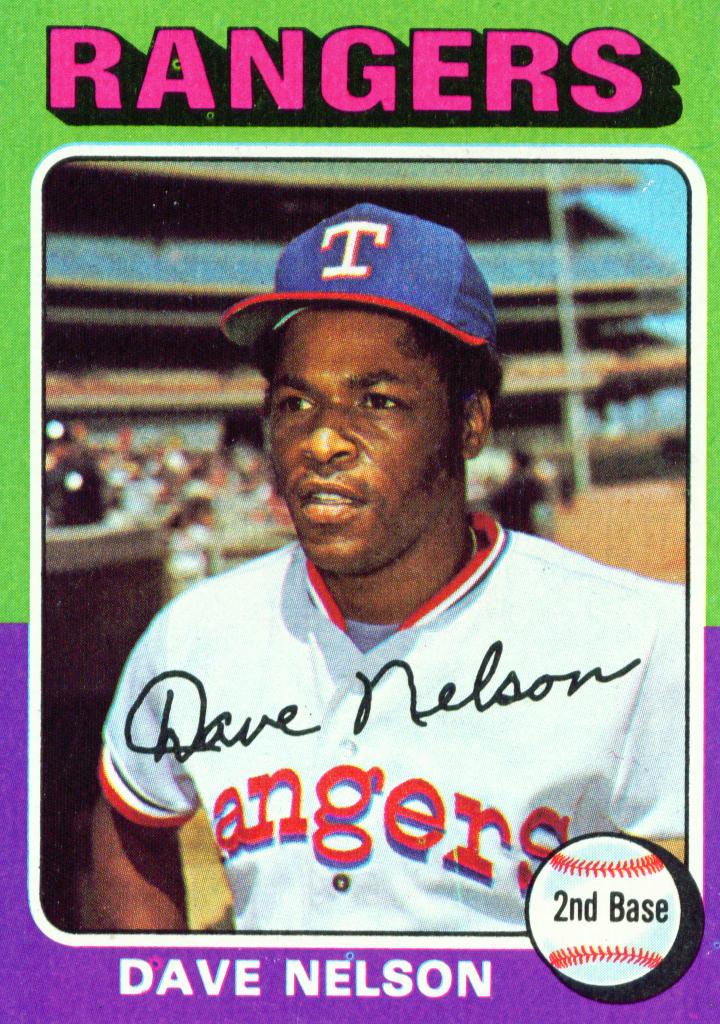
1975 Topps - Dave Nelson.

So far the only news out of Spring Training is that Yu Darvish is in camp and the Japanese media is going bonkers.

Dave Nelson, shown here on card number 435 of the 1975 Topps set, was feeling the squeeze in 1975. Young Toby Harrah and Roy Howell had pushed Len Randle over to second base. That left Dave as the old and odd man out - he was 31 years old and had been battling injuries.

The result was a pretty major dip in Nelson's playing time. Appearing in just 28 games he would make only 92 plate appearances. Probably as a result of lack of use, his batting average would drop to .213. However his on-base percentage would stay almost steady at .289. Neither were particularly good numbers. Dave was also slowing down a bit - he stole just six bases all season.

On defense Dave would play just 182 innings, all at second base. He would commit five errors for a .959 fielding percentage. That was 16 points below the league average.

With Lenny Randle seemingly firmly entrenched at second base and Toby Harrah at shortstop the Rangers apparently had no room for Dave Nelson. On November 12, 1975 they traded him to the Kansas City Royals for pitcher Nelson Briles.

Monday, February 20, 2012

Minor League Monday - Barry Winford, 1990 Best.

Well, Spring Training is officially under way. Good stuff. So far there have been no major waves coming our of Surprise, Arizona.

Barry Winford shows up on today's minor league post and on card number 187 of the 1990 Best set. The Rangers had gotten Barry in 1989 although I can't find any record as to how they got him. He played for the Butte Copper Kings that year and tore up Rookie ball. In 1990 he would be promoted to Single A and model his new Gastonia Rangers uniform for the Best photographer.

No matter how you look at it, 1990 was a rough season for Barry Winford. In 379 plate appearances he posted a .238 batting average. That was 121 points lower than the previous season. His on-base percentage also tumbled by 140 points to .324. The slugging percentage fall was even uglier - 189 points to .316. Additionally Barry walked the same number of times but struck out an additional 43 times.

Winford struggled behind the plate as well. In 89 games he committed 12 errors. That dropped his fielding percentage to .983 - an eight point drop from 1989.

Barry Winford did not make the transition to Single A ball well. That was clear. What was also clear was that he needed to catch fire and fast. Part of what threw his struggles into sharp contrast was the fact that a young Ivan Rodriguez had come through Gastonia just one season previous. Any catcher hoping to avoid being blocked by Pudge needed to make a big impression early on. So far Barry hadn't done that.